






















































Let’s imagine for a second that our planet is dying. Can you picture that? Look, I know it’s hard to believe, but you have to try. Please, for the good of this review, I beg of you!
Got it? We cool? Okay.
Let’s imagine for a second that our planet is dying. But it’s not just our planet: it’s our sun. Apologies to any basement hermits reading this review and being forced to think of the sun — we surface-dwellers sort of need it to survive, and the fact that it’s dying is not ideal.
So, yeah: in this imaginary scenario, our sun is dying — which has never happened in any popular science-fiction movie before this one — but it is not alone. Every sun in a multi-light-year radius is being dimmed and destroyed by some form of light-eating organism, and no scientist knows how to stop it.
Good news: there’s one star amidst a field of dead ones that is somehow surviving the attack, and if science can tell us why, then we’re golden. Bad news: the only way to analyze it is to send a team on a spaceship with a one-way ticket to deep space to research, relay and relax; or decode, deliver and die. Things may seem a darker sort of golden now, but that’s what Project Hail Mary was created by the government to do: lighten the gold.
Now imagine a spaceship, the “Hail Mary,” carrying a scientist. He’s traveling light-years alongside two other people: a pilot and an engineer to complement his non-spaceship-related know-how. Unfortunately, his competent crewmates died in transit, and the scientist is now alone, helpless and hapless on a mission to save humanity.

In “Project Hail Mary,” Ryan Gosling plays middle school science teacher Ryland Grace (a stunningly similar name), who wakes from a coma on a space shuttle with no memory, no crew and a whole lot of vodka. Now Grace is pacing without a trace to place his race, and he’s getting s***-faced while bracing for whatever star-saving he’s meant to ace on this space base.
He’s scared, sarcastic and oh-so alone — but only until forty minutes in, when he becomes scared, sarcastic and not so alone, after he meets the supposedly-supposed-to-be-a-spoiler alien all the trailers kept shoving in people’s faces: Rocky.
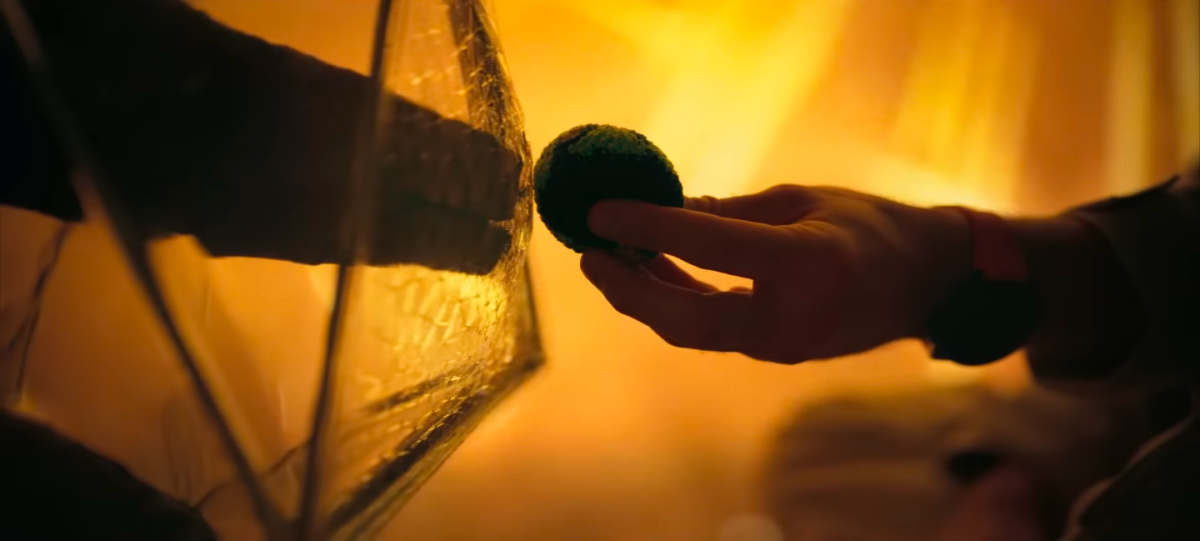
Rocky is a weird, goofy golem-looking alien who can somehow construct any shape out of solid Xenon, and his sun has the same infestation as Grace’s. Through the power of “Arrival”-esque language technology to form a lingua franca, Grace and Rocky put their respective hands and hand-adjacent appendages together to find what’s killing the stars and save both their species from extinction.
Are you still imagining? Okay, good. I was worried you actually thought aliens were real for a moment. Can you even imagine that? That would be crazy, huh?
As out-there as “Project Hail Mary” may seem, Drew Goddard somehow managed to adapt Andy Weir’s acclaimed book into a comprehensible, believable screenplay. “Project Hail Mary” is full of great jokes, emotional gut-punches and some fantastic scenes with minimum dialogue a la “The Martian.” This movie is shockingly similar to “The Martian” in just about every aspect, minus the silly little rock alien, which makes so much sense when you realize Weir wrote that movie’s book, too — and Goddard wrote that movie’s screenplay, as well! Glory be, Lennon and McCartney are still working together!
And just like “The Martian” was a visual milestone back in 2015, “Project Hail Mary” continues to set the technological bar 11 years later with the same VFX crew. This film is visually outstanding, and it blows my mind that zero greenscreen shots were used in the final cut. This is some top-tier “Interstellar”-looking work, guys! There were just as many brain-boggling spaceship builds as there were fictional micro and macroscopic organisms, and it all felt just as real as the Pibb Extra nervously quaking in my right hand every second.
My Pibb Extra never stopped bobbing, even when I wasn’t holding it, and that’s largely due in part to the impressive sound design to complement the visuals. Big booms and crazy sci-fi sounds I’ve never heard before. When you get those drink-shaking ripples by just sitting in the cupholder, then your movie’s got some A1 sound design.
But that’s if the visuals needed any complementing in the first place, and they really didn’t, thanks to the camera wizard that is Greig Frasier. Having been the cinematographer for both Villeneuve’s “Dune” films and Star Wars’ “Rogue One,” Frasier is no stranger to science fiction. But he captures “Project Hail Mary” through such a unique lens (pun intended) that nearly every onscreen second feels larger than life in the most breathtaking of ways. Every shot, no matter how cluttered the screen may look, comes off as oh-so meticulously positioned and often indescribably gorgeous compared to even Frasier’s grandest of projects. He harnesses the popping palettes of colorful planets to shoot vibrant, entangling environments that blend the dreamy fiction of “Project Hail Mary” with the grueling reality of “The Martian.”
If Frasier doesn’t get an Oscar nomination for Best Cinematography for this, then I don’t know what will. Friggin’ “Animal Farm?” No, please. God, no. Keep those animals out, Fraiser!
Daniel Pemberton rounds out “Project Hail Mary’s” plentiful feast for the eyes and ears with another one of his amazing original scores. The composer of both “Spider-Man: Into the Spider-Verse” and its 2023 sequel returns to the sci-fi genre with a grand musical showcase that ranks among the former as his best work yet. Pemberton utilizes a wide variety of strings, synths and choral voices to make his tracks elevate the visuals onscreen, and it’s impressive just how much bigger the dude can make the boundless chasm of outer space feel.
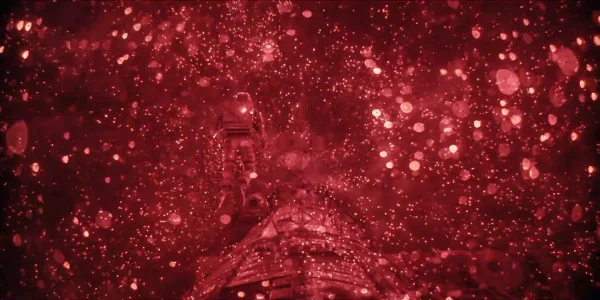
To really drive home how impressive “Project Hail Mary” is on a technical level, I simply have to talk about one of my favorite scenes in the movie. There’s a particular part around the movie’s halfway mark that’s bathed in this astonishing pink light. Thousands upon millions of particles flurry around Grace as he floats around his spaceship, basking in the beauty of it all. The gigantic VFX feat plus some genius camerawork from Frasier and those grand compositions from Pemberton equal … “a moment…” that stuck with me for longer than I ever could have imagined. That’s cinema, baybee.
But that scene wouldn’t be complete without Grace, portrayed by the ever-talented Ryan Gosling. And to really tap into the deep emotional chasms of Ryland Grace, Gosling finally evolved into Goose.
Gosling is really fun as Grace, and plays a part eerily similar to … you guessed it: Matt Damon in “The Martian.” He fluidly captures the character’s humanity and natural, defensive sarcasm while also effortlessly plunging us into this isolating space story as if we were there beside him. It’s a very empathetic performance that Gosling gives: one that makes you laugh and chuckle just as much as it makes you scoff and stare in unbridled shock. He made me cry several times, and that alone should get him an Oscar nomination. Plus, his only scene partner was a half-VFX, half-puppet rock alien, so “Project Hail Mary” really is just “Project Gosling Best Actor 2026,” and I’m a happy campaign donor!
Although if I had one gripe with the riches-abundant “Project Hail Mary,” I would be inclined to mention the questionable pacing. I was a big fan of Goddard’s screenplay, but this movie could have easily had thirty minutes chopped off its butt end. My father is not a long movie fan (he’s a “one hour, thirty minutes” purist), so he was not a happy camper in that regard, and neither was I. The extra weight wasn’t necessarily bad, but it led to some excess tonal bleeding and a minor lack of shot variety that all could have been remedied by just taking the load off and calling it there. At least the movie’s good enough to rise above its flaws and save humanity as well as cinema itself.
Directors Phil Lord and Christopher Miller present “Project Hail Mary” after more than a decade of directorial absence. While the two took producer credits for the “Spider-Verse” movies and “The Mitchells vs. The Machines,” neither Lord nor Miller has yelled “action” since 2014, when they pulled double-duty and helmed both “22 Jump Street” and “The Lego Movie” together that same spring. The last Lord/Miller action was them being cut from “Solo: A Star Wars Story” four months into production and getting replaced by Ron Howard.
So their last sci-fi caper went kaput — big whoop! At least “Project Hail Mary” went over smoothly. With a haul of over $140 million worldwide from just its opening weekend, I’ll bet we’re gonna be talking about this movie for far longer than any person ever talked about “Solo.” I’ll also bet you fifteen bucks that the above paragraph was the first you’ve heard of “Solo” in the last five years.
Wait, scratch that. What am I doing? You’re gonna need those fifteen bucks to buy a ticket to “Project Hail Mary” this week! Even if you aren’t on spring break (but especially if you are), get your butt off of your couch, drive straight to your local theater and sob uncontrollably at a charming, faceless rock for two hours and thirty minutes. It may seem like a long time to just sit and observe, but when you’re working to save humanity from extinction, you kinda need all the time you can get to fully immerse yourself in your environment — sorta like the guy in “The Martian.”