




































Simply being on the phone with Chelsea Maldonado was enough for Kristina Beihofer to feel nostalgic about their time as teammates on the Prospect cheerleading team from 2012 to 2016. As they recalled some of their favorite memories together, Maldonado explained how she was now a JV coach for the team and wanted to know if Beihofer had any interest in being a volunteer coach.
Having reflected upon her time on the Prospect team, Beihofer knew she couldn’t say no.
“It just felt surreal,” Beihofer said. “Coming back to Prospect and doing stuff with the cheer team, but now being in a more leadership kind of teaching role, as opposed to the athlete, was very different.”
Beihofer is currently one of Prospect’s 17 volunteer coaches that work across nearly all of its athletic programs. One thing that Athletic Director Scott McDermott pointed out is that the word “volunteer” can sound misleading — as if the school is simply letting random people volunteer. However, this could not be further from the truth. All of Prospect’s volunteer coaches go through nearly the same hiring process as the coaches.
After a varsity head coach presents McDermott with a name, the school will do a background check to ensure they meet the school’s values and expectations. They then go through the Illinois High School Association (IHSA) and meet their requirements for being a coach, which include finishing CPR training and earning online certifications. Once that is all complete, they sign off on the district’s handbook that lays out the rules that coaches need to follow in terms of handling money, transportation and communication with athletes.
With all this being said, McDermott also considers whether or not the addition of a new coach would do more harm than good.
“It’s a big commitment,” McDermott said. “We don’t want somebody just kind of showing up whenever. To me, if you’re going to volunteer, I’m asking you, ‘Well, what does your time look like?’ Because sometimes somebody randomly showing up is more disruptive than not having somebody there.”
In general, McDermott notes that the names brought to him typically have some relation to Prospect, whether they were former coaches that have since retired or an alumni. He attributes this pattern to Prospect’s unifying culture.
“A lot of these people had a strong experience while they were here, which speaks to a lot about what our coaches do and what our community supports, and they want to continue that in some way,” McDermott said.
Like Beihofer, Tim Raub is a Prospect alumnus, having graduated in 1998. While at Prospect, he was a distance runner, but while attending the California Institute of Technology he began to gravitate towards sprinting events in track and field. According to Raub, this opened his eyes to how technical the field events were.
With all of this exposure, Raub knew that he wanted to help his parents, who were already helping coach pole vaulting, at Prospect. He felt fairly confident coming in to coach, as his job as an environmental scientist requires him to instruct people and help them navigate through unfamiliar tasks.
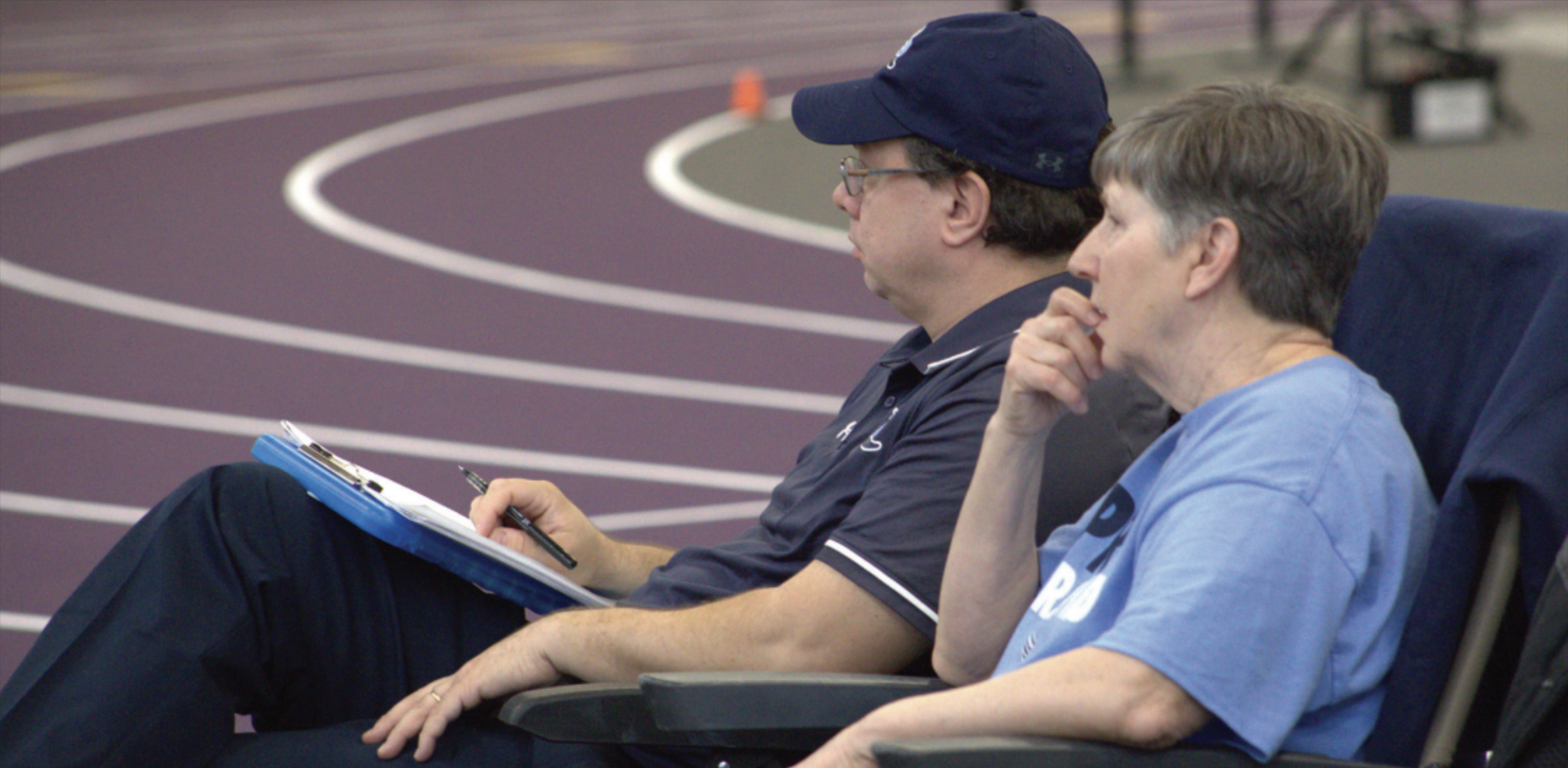
His main job is to help with the flow of the vaulters at meets because each attempt takes about two minutes. Even with just 19 girls in a single meet, pole vaulting can take nearly four and a half hours. Therefore, Raub spends a lot of time creating an organized system that keeps athletes flowing in a logical order. He also manages the safety aspects, like making sure that the bar is secure or that the pit is configured in a way that will cushion the landing for the athletes.
With all of this meticulous planning, countless hours go into planning and coordinating among coaches and athletes. McDermott stresses that, no matter the sport, volunteer coaches face their own battles in terms of time management between their personal lives and their coaching lives.
“[Our volunteer coaches are] providing a service to our athletes, in spite of what’s going on in their day-to-day world,” McDermott said. “You’ve got so much [community in Prospect sports] that you’ve got people that are saying, ‘Not only am I going to support it from a tax base, but I want to get in there and give my time and my skills and my value to the programs.'”
Beihofer faces this battle every day, as she currently lives in Chicago working with the Chicago Public Schools in the central offices and isn’t always able to attend every practice or competition.
“Sometimes [my time constraints] can be reflected in [the fact that] sometimes I personally don’t feel as confident instructing some of them because I feel I don’t know them as well,” Beihofer said.
Raub on the other hand, is self-employed, so it’s a little bit easier for him to maneuver his schedule to fit within practice hours. Because he lived in Scotland for 10 years with his family and has traveled internationally for his job, he has seen how different the coaching culture is in other parts of the world, where laws can sometimes prevent volunteers from coaching.
“The consequence of professionalizing all coaching and eliminating volunteers is [that] you eliminate opportunities and [the] number of openings for kids to compete,” Raub said.
Despite this challenge, when Beihofer shows up, she doesn’t hold back.
“Making the most of the time that you do have with the athletes and, obviously, remembering the [athletes] that you’ve worked with more in the past is really helpful, because then you can build those relationships the next time,” Beihofer said. “When it comes to cheer, at least, there are many people on the teams, so focusing on the relationships individually is helpful.”
What makes volunteer coaches unique is that they work without compensation, despite spending countless hours with their athletes. While most people might be put off by this, the fact never once impacted Beihofer’s decision to return.
“I honestly started [volunteering] because I just missed cheer. I missed being part of a sport. I miss working,” Beihofer said. “Just being back [at Prospect] and being part of the team again and doing what I can when I can, even if it’s not as much as I’d like — that’s fulfilling enough for me.”
Although volunteer coaches aren’t paid, Raub and Beihofer believe being a volunteer coach allows for personal growth.
“The other part of my job, being a scientist, involves constantly being proven wrong, and constantly being whacked upside the head by some piece of knowledge that you didn’t know that someone else knew or discovered that causes you to have to go back and rethink a whole lot of things,” Raub said. “So you have to develop working hypotheses that [you’re] always willing to revise and do a lot of self-examination.”
McDermott expresses that these moments of reflection are also shared among the coaching staff.
“Our coaches, they see what they see, right? Their [perspective can get] so narrow a lot of times … and sometimes all it takes is an outside lens to say, ‘Hey, have you considered this?'” McDermott said. “It’s that whole ‘step away from the tree to see the forest’ analogy.”
This extra set of hands has not only provided new perspectives, but additional help. McDermott also notes that volunteer coaches like Raub and Beihofer make it easier for a program to split into groups that can help target specific goals for athletes.
But at the end of the day, Beihofer and Raub note that the Prospect atmosphere is what has kept them going and committed to their athletes.
“I love the way that Prospect girls sing the fight song when they cool down around the track — no one else does that,” Raub said. “That culture is special, and it’s pretty unique to Prospect. And anyone can see that even at first [practice].”
Never miss important news: every Monday, get a preview of what’s going on this week at Prospect, and what went down last week. To sign up for the Knight Notes newsletter, click here.