






































Throughout your four-year journey at Prospect, a lot of things will change. Your friends, your interests, your dreams, your classes, and how car insurance companies value you.
There’s one thing that doesn’t change in your tenure, though. The dynamic pairing of a six-digit number and little plastic card.
Regardless of the door you enter, for four years, all Prospect students go through the same ritual. Granted, that ritual evolves. For example, taking the inevitably late school bus, then, a year later being driven by friends and eventually becoming the person driving friends.
However, the process once you enter the doors remains the same: shuffling up to the scanner, scanning your card and walking away having absolutely no clue why you just did that other than security guards’ reassurance that it’s extremely important to scan in.
School IDs, though, tend to be a sore topic among students. One in four Prospect students has been stopped for not having their ID, according to a KnightMedia survey of 141 students — this inevitably creates tensions between students and staff.
The IDs keep track of attendance, allow students to purchase food from the cafeteria for breakfast and lunch and grant entry into local sports games — however, the cause for most of the student hatred is their security application: processes like morning scan-ins.
According to Dean Adam Levinson, this safety facet is coincidentally the primary purpose of IDs. This is widely known throughout the student body, as 68.6% of Prospect students believe that the primary purpose of IDs is security.
What’s the trouble with student IDs being used in a primarily security capacity? It creates conflict and harms student/staff relationships at Prospect. This is something that school safety expert of 40 years Dr. Kenneth S. Trump says is more important than actual hardware like IDs and ID scanners.
Trump said that, generally, when he examines lawsuits on everything from infamous school safety tragedies to minor incidents, allegations of failures largely focus on human failures. For example, things like relationships, policies, procedures, training and communications — not failures of safety products and technology.
“It takes a balance of hardware and heartware … the human piece is the really important part,” Trump said.
Prospect invests heavily in the hardware aspect: there are cameras everywhere, monitored entrances and exits, and vestibules and reinforced windows with thicker glass. There are ID policies that require students to bring their IDs daily and pay $5 if they forget it.
Campus security guard Erik Hammerstrom explained he doesn’t believe these policies harm “heartware” like student-staff relationships and school culture.
“It’s not that big a deal,” Hammerstrom said. “Most students are pretty good about getting [a new ID.]”
Hammerstrom explained that he and the other campus security guards work hard to build connections with students.
“That school cultural piece pays off,” Hammerstrom said. “You talk to students about their daily activities and what they’re into. It helps build relationships.”
Although Prospect’s security staff works hard to promote relationships as Hammerstrom correctly asserted, the IDs’ use in a security capacity detracts from these efforts. In addition to IDs, Prospect’s security apparatus includes tons of hardware, it also includes effective policies like the Raptor background check, which is used on any visitor to Prospect during school hours.
This hardware — things like vestibules — is effective. These concrete systems keep threats out as long as they’re used consistently. IDs, regardless of their omnipresence, are not used consistently. It all comes back to one technical sounding term: fidelity of implementation.
Fidelity of implementation is just another word for consistency — the policy needs to be equally distributed in the same way to everyone, regardless of situation. According to Trump, it is hard to enforce that in a school setting. ID scanners are only at select doors, and there’s only so much security guards can do to make sure every student scans in.
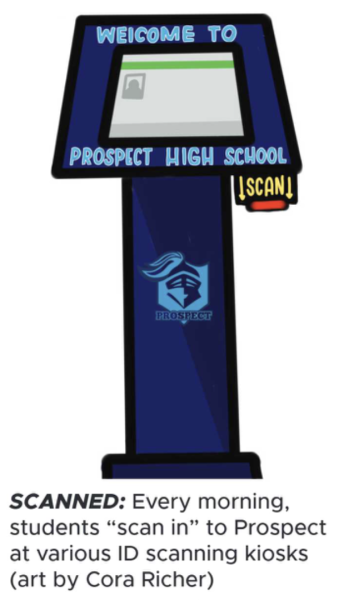
A major trait is at fault for this inconsistency: the system’s scale. Due to our large student population and large building, it’s largely unenforceable. That lack of feasibility and huge enforcement component is why Trump rarely recommends ID systems for security purposes. Levinson acknowledged the difficulties with consistent enforcement.
“We can make sure we minimize the risk, minimize danger [and] everything else, to keep you all safe, but there are going to be loopholes always,” Levinson said.
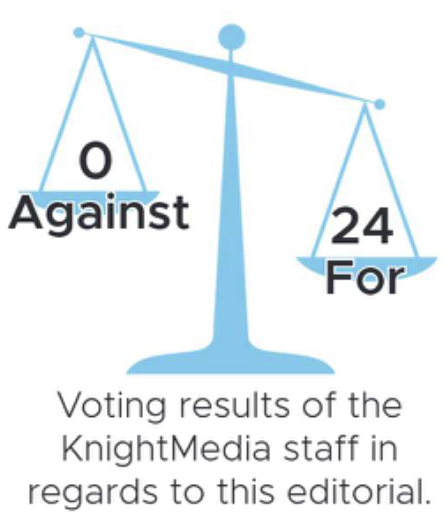
We, KnightMedia, acknowledge how annoying IDs are, particularly due to the scale of the ID system, which makes it largely impossible to enforce consistently. We support the “heartware” that our security guards are providing on a daily basis, but the system detracts from security staff’s effort to build connections and relationships with students.
However, since Prospect has an open campus policy, there needs to be some sort of security system when students come and leave school.
And therein lies the special catch when it comes to Prospect’s security situation: the open-campus policy.
Trump emphasized that open campuses are security risks and not recommended, which might be why only 37% of American schools have open campuses, according to the National Institute of Health. Oftentimes, schools have open campuses for two reasons: tradition and space. Prospect is a bit of both, but more the latter.
“At any given time, it’s very hard to keep all 2,200 [people] in here at the same time, which is part of the reason also, we allow for open [campus],” Levinson said.
Trump says he more often sees IDs used in a multifunctional capacity, and not a security capacity — students need an ID to purchase food, use vending machines and access amenities, like a weight room. When students need their ID to do things, they start to value their IDs. When students value their IDs, they bring them.
“It tends to be more [used for] student life,” Trump said. “We honestly don’t see a lot of schools using student IDs [for security.]”
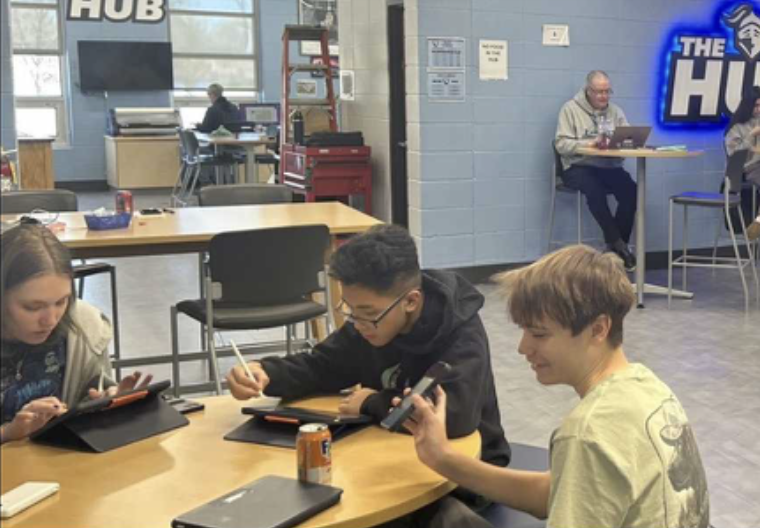
Prospect uses IDs for student life functions like purchasing food from the cafeteria, checking out books or laptops out and signing into rooms like the ARC and test retake center. Student life is a good use of IDs — security is not.
Although IDs are annoying and filled with flaws, they’re necessary as long as Prospect maintains an open campus policy.
Never miss important news: every Monday, get a preview of what’s going on this week at Prospect, and what went down last week. To sign up for the Knight Notes newsletter, click here.