

















































![TEAM SPIRIT: A cheerleader throws their pom-poms above their head. The anonymous ex-cheer student loved cheerleading, but felt her environment was too toxic to continue. "I was just so scared of this coach," she said. "[I was scared of] the constant yelling at us and the way it was very much like, 'You're replaceable.'" (photo from Canva)](https://prospectornow.com/wp-content/uploads/2026/04/Purple-Pink-Dark-Mode-Pictogram-Gender-Equality-Social-Issues-Instagram-Post-e1775594453495.png)
From the first moment she remembers seeing them on TV, a senior student, who does not attend Prospect, wanted to be a cheerleader. She cheered all throughout elementary and middle school, so when her eighth grade year arrived and the time to try out for cheer at high school came with it, it seemed like a natural next step.
“For my freshman year, I was obsessed with the idea of cheerleading,” she said. “I assumed, ‘Oh, this is something I love. [It’ll be] perfect.’”
But when the cheer football season actually rolled around, the student met her varsity coach, and things took a turn for the worse. He was results-obsessed, a frequent yeller and known to punish cheerleaders with intense cardio for ordinary mistakes. When his athletes were running laps, he would tell them he didn’t care if they vomited or were out of breath — they could only stop when he allowed them to.
In one of many particularly painful memories, the student dropped a stunt and was made to run a half-mile around the track. As she was an inexperienced runner at the time, she remembered wanting to dash to the trash can to throw up.
“But [my coach] just gave you the impression that he [didn’t] care,” the student said. “Like, ‘You’re part of this team. That’s all that matters.’”
Abusive coaching: what it is and where to find it
Abusive coaching, though people didn’t realize it at the time, used to be a very apparent problem. Athletic Director Scott McDermott, who played high school baseball and football at Prospect in the ‘80s, says coaches at the time were more results-driven, indifferent to athletes’ physical wellbeing and given to using personal attacks. In high-pressure spaces like this, coaching was more likely to cross the boundary from merely vigorous to emotionally and physically abusive. 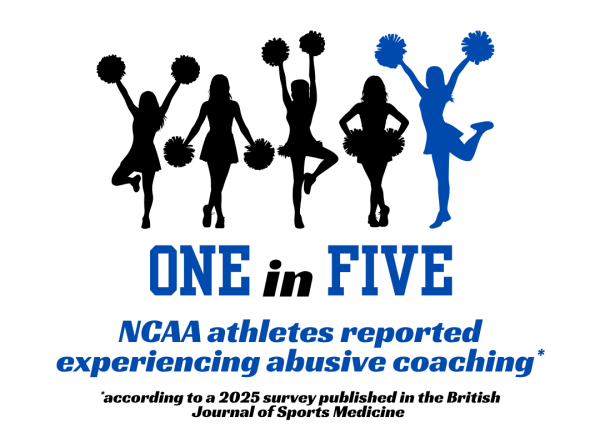
He remembers an end-of-the-year banquet where his own football coach would place joking write-ups at each of his players’ seats. His read, “McDermott blows the game again.”
“And [my coach] wasn’t wrong. I’m sure I did,” McDermott said. “But we would not do that [nowadays]. That’s just not something that’s good for people.”
Despite this, abusive coaching still happens today. A 2025 survey of National Collegiate Athletic Association athletes published in the British Journal of Sports Medicine had nearly one in five respondents reporting experiencing abusive supervision from coaches — and though the subjects were college athletes, trends in college sports are noticed by high school coaches and known to “trickle down.”
How, exactly, do people tell when a coach’s methods cross the line? Personally, the ex-cheer student knew something was wrong when her sport began to affect her academics. 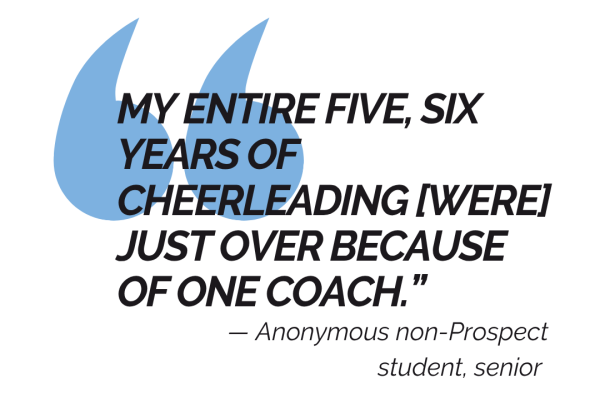
“It made the school days very hard because I would be sitting in my second period class scared to go to practice,” she said. “I wasn’t thinking about the math on the board. I was thinking about, ‘Oh my God, what’s going to happen at practice today? I don’t want to go to practice today. What’s [my coach] going to say at practice?’”
The daily terror took a toll. She began to feel so scared she became nauseous, experienced stomachaches and skipped school to avoid going to practice out of fear of seeing her coach. When her first football season ended and it was time to re-try out for the competitive winter team, the student, after many conversations with friends and family, decided she couldn’t take it anymore.
Quitting was hard. The student said that for a long time, she would sit at home crying, feeling directionless in the void where two-hour cheer practice used to be. But no matter how difficult not being on the team was, she saw no other way forward.
“My entire five, six years of cheerleading [were] just over,” she said, “because of one coach.”
Why does abusive coaching still happen today?
Recalling the difference between his experience playing high school football and baseball at Prospect in the ‘80s and observing Prospect’s coaches’ behavior now, McDermott described a seismic shift.
“Back then [in the ‘80s, the popular coaching style] was more fear plus intimidation. [That mix] was in many ways used as a tool,” McDermott said. “We don’t do that. We’re much more grounded in the people and making sure that we stick the kid in the center of everything and then we wrap them in experience and then in relationships.”
He believes, though, that even though the culture has evolved, one cause for abusive coaching is the same as it’s always been: coaches lose sight of the values that belong in a high school sport and instead prioritize winning.
“Any time [coaches] neglect to treat people kindly as humans, [they’re] going too far. When that typically happens, [they’ve] lost sight of [their] purpose and what we’re doing,” McDermott said. “It’s great to win, but it should be the least impressive thing about our teams. Our teams should be about creating a community that people are going to look back on and learn from and grow from.”
Experts agree that coaches, and the school administrations that hire them, can still prioritize a trophy-laden record over knowledge of education, ethics and psychology and the ability to foster a positive team culture.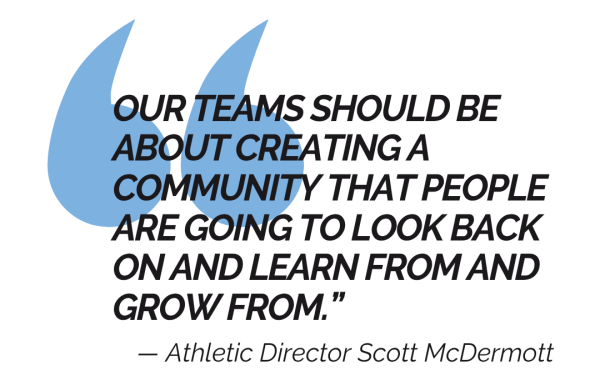
“Coaches are, in surprising numbers, poorly educated on coaching, let alone the psychology of coaching. It isn’t their fault — no one is making them learn,” sports psychologist Mitch Abrams wrote in a Psychology Today article. “Coaches get the reputation of being good coaches more by wins and losses than the way they assist an athlete in developing into the best people they can be.”
Sports Consultant Dr. Alan Goldberg links this prioritization of winning with both personal insecurity and coaches’ worries about their careers, saying the fanatical avoidance of failure isn’t bottom-up, but top-down.
“[Coaches can] believe that an athlete’s performance failure is reflective of a coaching failure,” Goldberg wrote in a 2015 email newsletter. “And why shouldn’t they feel this way when coaches at every level are regularly criticized and fired for not winning enough?”
The student’s team is considered competitive, frequently qualifying for state — yet that didn’t stop her from voicing objections to her coach’s methodology. She and her mother contacted her school’s athletic director, but, even though “at least one or two” other parents had also complained of misconduct, she says there have been no signs of investigation.
“I know there were other people on the team that didn’t agree [with the coach’s methods] and were a little fearful,” she said. “But nothing changed.”
The student’s coach still works for her school today.
After abusive coaching: the path to peace
As she started her journey of recovering from her experiences on the cheer team, her coach’s presence, while not continuous due to him not being a teacher at the school, made moving on difficult. The student’s strongest reaction to him after quitting came the first time she saw him in the hallway.
“I was thankfully near a teacher’s classroom that I knew. I just walked in there and my heart started racing. I froze and had a panic attack in my teacher’s classroom just because seeing him was so triggering,” said the student, who has Generalized Anxiety Disorder. “It’s gotten easier over the first few times of seeing him, but [for] the first few, it was a jolt.”
The student has been going to therapy since eighth grade, and says her therapist has been a crucial part of her healing process. One hurdle she helped her overcome was when the student wanted to go on daily runs “just for [herself], not for a coach,” but found her mind kept yanking her back to the past.
“It was so hard for me to get into [running] because any time I would go for a run, in the back of my head, I just had ‘Don’t stop. I don’t care if you throw up’ just replay on repeat,” she said.
 With time and her therapist’s support, that changed. The student now enjoys a run every morning.
But her therapist isn’t the only one who’s helped the student pave a way forward after cheer. Quitting the team gave her time to pursue her real passion: helping disabled children. The student, who will study special education in college next year, now works as the assistant coach for a local Special Olympics girls’ basketball team. She strives to break the cycle of abusive coaching, cheering on her players regardless of their performances.
“Not every game is going to be great. But you have next game — you have the next quarter of this game,” she said she often tells players who feel they’re not good enough. “Make a single basket and I will be so proud of you. Stay in the game and I will be so proud of you. Sit on the bench and cheer for your team and I’ll be so proud of you. No matter what you do, I will be proud of you.’”
This March, the student’s Special Olympics team got second in state.
Advice to remember
However, her journey of recovery hasn’t been completely straightforward. The student had to rebuild her social network after quitting because all of her friends were in cheer, and though she’s found a higher quality of bond with her new group, four years later, she still avoids talking about her past. And even though cheerleading was a sport she had loved since childhood, she doesn’t think she’ll pick up a pom-pom — or play in any sport, for that matter — ever again.
No matter how long and hard the path to healing has been, though, the student’s message to other athletes in similar situations isn’t one of resignation. It’s one of hope.
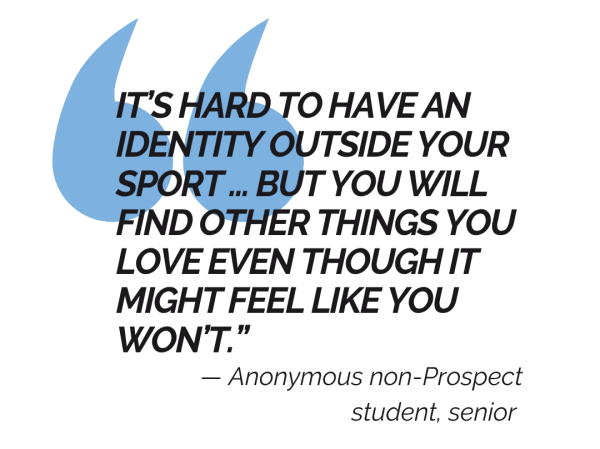
“It’s hard to have an identity outside your sport. For a long time [I] was like, ‘Oh, I’m a cheerleader. That’s what I do. That’s what I love,’” she said. “But you will find other things you love even though it might feel like you won’t. You’re going to have so many opportunities that will be positive once you’re not on the team anymore, even though it will not feel like it in the moment.”
When the student thinks of young athletes facing abusive coaching, someone in particular comes to mind: a younger cheerleader in another school who is having a similar experience, but is scared to leave the way she did. The student says she sees herself in this girl and knows what she’s going through must be “scary,” but also trusts her to decide what her own future will hold.
“Whether she stays on the team or doesn’t try out again is totally up to her. But I’ve kind of left my mark on her [by saying], ‘If you stay, I’m proud of you. If you quit, I’m proud of you. And if you do quit,’” she said, “‘I’m proof that you’ll be fine and you’ll find other things you enjoy.'”
Never miss important news: every Monday, get a preview of what’s going on this week at Prospect, and what went down last week. To sign up for the Knight Notes newsletter, click here.