














































“How do you respond to people who suggest that [homosexual relationships] are disgusting?”
This is what one reporter asked Heath Ledger while on the press tour for “Brokeback Mountain,” shortly after its release.
“I think it’s immature, for one,” Ledger replied. “I think it’s an incredible shame that people go out of their way to voice their disgust about two people who wish to love one another.”
It’s easy to forget gay marriage was only fully legalized in 2015. Acceptance of LGBT+ stories has skyrocketed in the past few years, largely due to its increased prevalence in mainstream media. One early example of this is “Brokeback Mountain.”
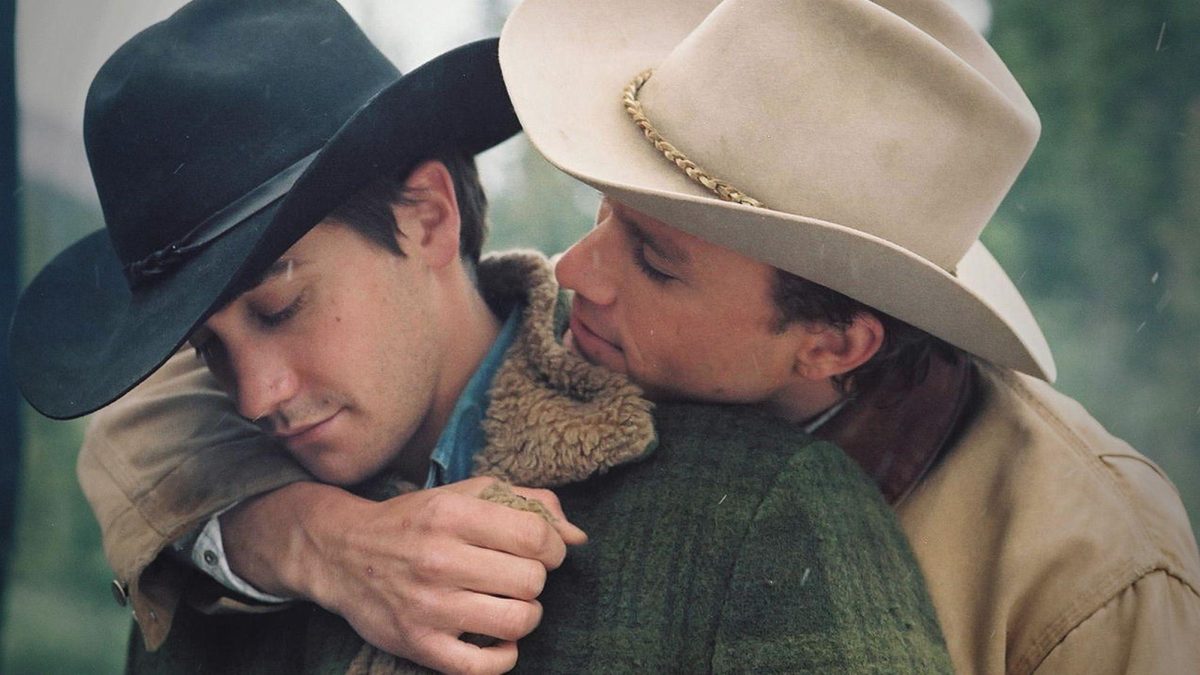
“Brokeback Mountain” is a film adaptation directed by Ang Lee and based on the short story written by Annie Proulx. The story is both a western and a romantic drama, following characters Ennis Del Mar (Heath Ledger) and Jack Twist (Jake Gyllenhaal) as they herd sheep during the summer of 1963. Both Del Mar and Twist are portrayed as masculine ranchers drifting through life, but over the summer they find unexpected romance in one another.
The movie was released on December 9th, 2005, just over twenty years ago. Previously successful films about queer love include “Birdcage” (1996), a comedy, and “Philadelphia” (1993), a movie surrounding the AIDS crisis. In contrast, “Brokeback Mountain” was the first commercially successful film to portray a serious and romantic love story between two men.
However, getting the film made wasn’t an easy task.
“It was a laughing stock – the gay cowboy script,” producer James Schamus told Vanity Fair. “I don’t think people got over the punchline.” Schamus acquired the rights for the film in 2001, reporting that many other producers had passed the screenplay over, and every pitch he made to studios had been dismissed.
After Schamus established Focus Features, a specialty division of Universal Pictures, he was finally in a position to bring the screenplay to life as a movie. While originally hoping for a gay director to take charge, he chose Ang Lee not just for his prior success in films like “Sense and Sensibility” (1995) and “Crouching Tiger, Hidden Dragon” (2000), but also for his enthusiasm towards “Brokeback Mountain.”
“The film spoke to me in a very existential way,” Lee told Vanity Fair. “It had been three years since I first read the short story, and I just couldn’t forget it.”
Finding actors willing to play gay men as the film’s lead proved more difficult, though. Matt Damon and Mark Wahlberg dismissed the role, among many other unnamed actors.
“The idea scared people back then,” Lee said. “The cowboy is an American hero symbol. Something about it, people [found] funny.”
According to the Golden Globes, Gyllenhaal stated that “when I first got the material and heard it was a gay cowboy movie, I wanted nothing to do with it.” Like many actors in the early 2000s, he was reluctant to star as a gay man. It wasn’t until the actor, who went on to play Jack Twist, read the entire script that he had a change of heart.
“When I realized what [the movie] was really about, then my goal was to fight to play whatever part I could get,” Gyllenhaal said. “To me, the most interesting thing about the film is how, if we all had our space where society didn’t impose their ideas on us … and we were to take the person that we love now, would we still love them?”
Finding an actor willing to play Ennis Del Mar was more challenging. One unnamed actor dropped out of the project five months into production. Schamus, upon seeing Ledger enter the casting studio, immediately thought the Australian actor was fit for the role. It helped that Ledger had already played a gay man on the television show “Sweat.”
Despite the difficulties in delivering “Brokeback Mountain” to the big screen, the movie made almost $180 million worldwide, despite a budget of only $14 million. The movie was nominated for many Oscars at the 78th Academy Awards, including Best Picture, Best Director (Lee), Best Actor (Ledger) and Best Cinematography, among others.
Of the awards it was nominated for, the film won Best Director, Best Adapted Screenplay, and Best Original Score. The film was also nominated for and won several other awards at different shows.
“Crash,” a film about racial tensions in Los Angeles, ultimately beat out “Brokeback Mountain” for Best Picture in the Academy Awards, a decision that is still considered controversial today. Some reviews praised the film for having the potential to “make audiences better people,” while others described it as having a “toxic cloud of dramaturgical pixie dust.” The movie received an average rating of three stars on Letterboxd with community reviews ranging from profanities to praises.
Brokeback’s loss came as a shock to many people. It has an average of 4.1 stars on Letterboxd, with many reviews still lamenting its loss to “Crash.”
“Everyone expected us to win,” Lee told Deadline. After Oscar voting had ended, Shamus apparently set up a video meeting with his team to warn them there was a real possibility they would lose the Best Picture award.
“I’m glad that we did that; people were really upset,” said Schamus.
Despite its loss, “Brokeback Mountain” has arguably left a larger impact on the history of film than “Crash,” opening the door to future stories of queer love. In 2018, the film was added to the National Film Registry, a collection of films preserved in the US for their cultural relevance.
In the film, after the summer that Twist and Del Mar spent together, they returned to their “regular” lives, as they didn’t believe their relationship could succeed publicly, given the prevalence of homophobia in the ‘60s; Illinois was the first state to decriminalize homosexuality in 1962. The movie takes place in Wyoming, where same sex acts were prohibited by law until 1977.
Every step of “Brokeback Mountain’s” production was a struggle, and despite commercial success, the movie stirred controversy among audiences. The impact it’s made on queer history cannot be understated, as it forced viewers to confront prejudices they may have previously ignored.
Twenty years later, the movie is almost always spoken about with fondness, though there are a few prevailing criticisms. Most notably, the lead actors, director, and producers are all presumably heterosexual.
Gyllenhaal himself told the Gay Times that “part of the storytelling is that we were two straight guys playing these parts. There was a stigma around it … and I think it was very important to [Ledger and I] to break that stigma.”
Others criticized the film for its heteronormative portrayal of a gay relationship.
“It’s a movie about gay people delivered through the lens of straight people,” said Tyler Coats from Decider. “Then again, it’s probably valuable for people to see and understand the ‘normalcy’ … of the gay experience. And that’s OK!”
It’s important to remember how far gay rights have come in the past twenty years. If “Brokeback Mountain” were to come out today, it would not be nearly as remarkable, simply because gay romance isn’t as bewildering to mainstream audiences as it was in 2005. Many members of the LGBT+ community felt like the film was an important step in the right direction for queer media.
“Everyone in the movie — we got this overwhelming sense of open-heartedness and gratitude [from the gay community],” said Gyllenhaal.
The worldwide commercial success of “Brokeback Mountain” helped other queer films, like “Milk” (2008) and “The Kids Are All Right” (2010), receive a green light in production. The movie was also featured on the New York Times “Best 100 Movies of the 21st Century” list, and on the British Film Institute’s “30 Best LGBT+ Films of All Time.”
Ultimately, the film is a story of tragic loss, of romance unable to survive in the social climate of the 1960s. Twist and Del Mar are unable to pursue their love after their summer spent on “Brokeback Mountain” ends. As a child, Del Mar was shown the mutilated body of a gay rancher by his father; he lived in fear of meeting the same fate himself. Both characters go on to lead separate lives, finding women to marry and having children. The two only meet occasionally under the guise of a fishing trip. At the end of the film, Twist’s wife reveals that Twist died in a tragic accident; viewers are left to decide if this was really an accident or a cruel murder fueled by hate like Del Mar had always feared.
Even though society has made massive strides towards acceptance, homophobia is still prevalent in many people’s lives. “Brokeback Mountain” serves to remind us that queer love has only recently become accepted in the mainstream.
“Unfortunately, people are quick in life to label something that they’re uncomfortable with,” Ledger said on the movie’s press tour. “The pure fact of it is that it transcends a label … it’s a story of two human beings, two souls who are in love … we’re showing that love between two men is just as infectious and emotional and strong and pure as it is with heterosexual love.”
Never miss important news: every Monday, get a preview of what’s going on this week at Prospect, and what went down last week. To sign up for the Knight Notes newsletter, click here.