























































The following is the original opening paragraph for a story about Gemini Gems, before speaking with D214 instructional technology coordinator Katie Page:
“There are quite a few synonyms for ‘garbage.’ ‘Trash,’ ‘waste’ and ‘rubbish’ are just a few, but around here we call it ‘Gemini Gems.’ You should too.”
But you shouldn’t. Though we can’t blame you for thinking so. When an email was sent out to Prospect students on Oct. 20 advertising a Google Gemini-powered tutoring program that would be “your custom-built AI expert … taking charge of how you receive academic support, leading to better results and deeper agency,” many students and staff alike feared that this was the first step in replacing real, human educators.
“We just need to put our foot down,” junior and student tutor Harper Romberg said. “Students don’t need to use an experimental generative computer program when instead they could just learn from their peers and their teachers who have had college educations.”
Romberg’s concerns on the over usage of AI are, generally speaking, totally valid. Relatively speaking, AI is pretty new, and regardless of how much it advances in the future, it will never be able to fully replicate the education received from a real person.
However, Gemini Gems is not attempting to replace us of flesh and blood, despite how it may seem. Between the AI-written emails advertising Gems, AI-written follow up emails to our staff by Page, and the fact that Page herself played a large part in the creation of Gems, we were fully convinced that Gems was just more AI garbage, trash, and rubbish.
That is, of course, until we actually talked to Page.
As a former physics teacher herself, Page believes that there is no better education than that from a teacher. However, she also knows that teachers only have so much time and can only provide individual help to so many students before running out of class time.
“[Gemini Gems] lets students individualize their learning without having the teacher have to stop the entire class just to cater to one person,” Page said. “Although I could explain a physics concept to a [student] one on one, there’s still 28 other kids in the class sitting there. In the meantime, they could be working with some sort of AI to help pinpoint where they need more help.”
So if Gems isn’t the AI takeover we were fearing, what exactly is it?
As explained by Page, Gems differs from other AI programs in that it uses Google Gemini as a host for user-created characters, or “Gems,” to answer questions about the topic it has been fed information about. Teachers can upload lesson notes to a Gem, then share it with their students so if they are confused by any concepts in their notes and aren’t in class with their teacher, they can ask the Gem to put it in terms they can understand without pulling additional, potentially false information from other sources online.
Students can also create Gems, though they are less likely to be helpful, as Gems attempt to use only the information provided to them. Basically, if you create a Gem and only tell it that 1 + 1 = 2, then ask what 2 + 2 equals, it’s going to be forced to use the materials standard Google Gemini responds with to answer your question because you only taught it one thing.
As with anything powered by AI in the current day, Gems can get complicated quickly when one attempts to use it for more than simply rephrasing and elaborating information. This would be an issue if Gems was trying to be anything more than this, but Page intends for Gems to be a supplementary resource for students that is only enforced by teachers who put effort into creating a Gem, not those who want to cut corners in the learning process.
“Education is all about people and relationships,” Page said. “It’s going to be really hard for any kind of chat bot to come in and replace that because you need a human to [learn] … something like Gemini Gems makes us even more human, because we’re the ones that are going to do the critical thinking. We’re the ones that are going to have imagination and humanness.”
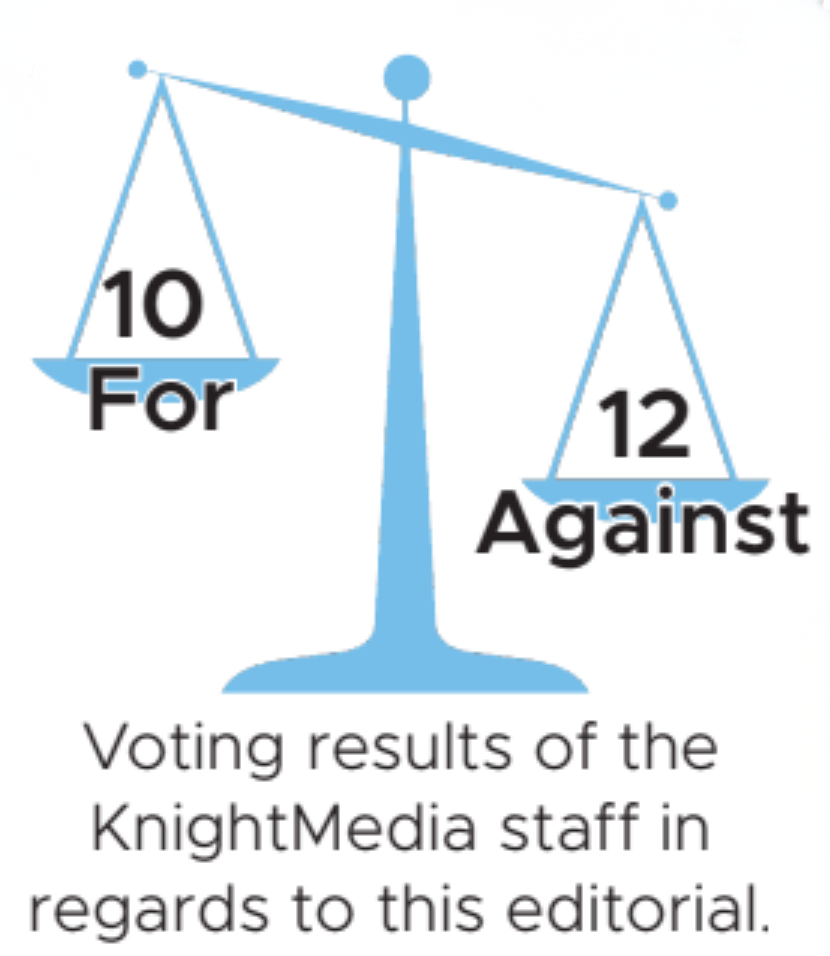 We, KnightMedia, believe that AI technology is an unavoidable part of the future that will inevitably extend to education. We believe it is better for District 214 to view AI neutrally as an optional resource for students who need help outside of the classroom rather than simply ban the use of AI altogether or push it onto the student body.
We believe that Gemini Gems, when used exclusively as a supplemental tool for education, can be a helpful resource for students who wish to extend their learning beyond the classroom or receive additional help during times when a teacher is not present.
Gemini Gems, and by extension AI as a whole, should never, under any circumstance, replace the positions of educators, but should not be fully ignored either. AI can exist as a supplemental tool in schools while still maintaining a positive learning environment.
Concerns about AI replacing human work are valid, but Gemini Gems is not the first step in this takeover. It’s important to understand that AI resources aren’t for everyone, but many can benefit from the support they bring. Not supporting AI programs is one thing, but actively criticizing those who use them as an accommodation for learning is harmful and unacceptable.
“[AI] is definitely here to stay,” Page said. “I view AI as a turning point for educators to envision the kind of education they would like. It gives us a chance to step out of the old system and create something new … [something] only our imaginations can answer.”
Never miss important news: every Monday, get a preview of what’s going on this week at Prospect, and what went down last week. To sign up for the Knight Notes newsletter, click here.